



China Visa Photo — 33×48 mm for COVA and Consulate
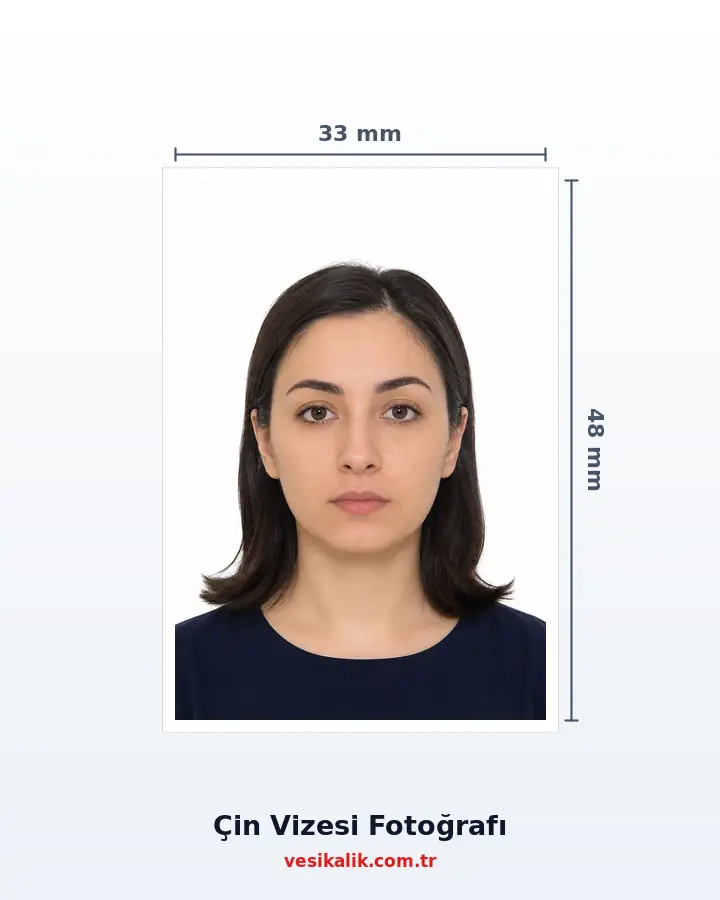
Prepare the 33×48 mm photo for a China visa application (COVA online form + CVASC appointment) with AI in 30 seconds — pure white background, both ears visible, bangs off the forehead, JPEG 40-120 KB / 354-420×472-560 pixels; the bangs rule that causes most rejections is checked automatically.
- Free analysis
- ICAO 9303
- AI-Powered
- GDPR compliant
Key takeaways
- 33×48 mm portrait — the only accepted Chinese consulate size
- COVA digital: JPEG 40-120 KB, 354-420×472-560 px, pure white #FFFFFF background
- Both ears and both eyebrows FULLY visible — bangs covering the forehead is the top rejection
- Colour (RGB) required — black-and-white is rejected; PNG/HEIC/WebP are rejected
Prepare the 33×48 mm photo you upload to the COVA online form and attach to the application at the Istanbul/Ankara CVASC appointment for Chinese tourist (L), business (M), student (X1/X2), family (Q1/Q2), transit (G), journalist (J) and work (Z) visas.
How it works
China Visa Photo — 33×48 mm for COVA and Consulate — get it right in 4 steps.
-
Tie hair BEHIND the ears and clear bangs off the forehead
This is the critical China-specific rule: both eyebrows and both ears must be fully visible, and bangs must not cover the forehead. You can use clips or bands — they stay behind the head, out of frame. Wear a dark or medium top (so it does not blend into the white background).
-
Shoot in front of a white wall, with glasses removed
Officially, thin-framed, clear, non-glare prescription glasses are allowed; but because the COVA automated checker rejects them often, removing all eyewear is the safest route. Head upright: ≤20° left/right, ≤25° up/down tilt.
-
Upload the photo and start the COVA check
The AI scores head height (28-33 mm), head width (15-22 mm), pure white background, both ears/eyebrows visibility, bangs detection and file size against the Chinese standard.
-
Upload the 33×48 mm digital to COVA, take 1 print to the CVASC appointment
The JPEG is optimised into the 354-420×472-560 px, 40-120 KB range automatically. 1 printed 33×48 mm copy on glossy photo paper is required at the CVASC appointment in Istanbul/Ankara — shipped to your address on a 10×15 sheet.
How much does an ID photo cost? (2026)
Photo analysis and the biometric compliance check are completely free. Digital file and print prices are below — identical to the live prices in the order wizard.
| Service | Price |
|---|---|
| Photo analysis & biometric check | Free |
| Digital File | 50.00 TRY |
| China Visa print package | 250.00 TRY |
| Cargo | 100.00 TRY |
Technical specifications
- Authority
- PRC Consular Department / COVA / CVASC
- Size
- 33×48 mm (portrait)
- Head height
- 28-33 mm (chin to crown)
- Head width
- 15-22 mm (ear to ear)
- Head tilt
- Horizontal ≤20°, vertical ≤25°
- Pixels (COVA)
- 354-420 px × 472-560 px
- File (COVA)
- JPEG ONLY, 40-120 KB
- Background
- Pure white #FFFFFF (cream/grey rejected)
- Colour
- Colour RGB required (black-and-white rejected)
- Ears
- Both ears FULLY visible
- Forehead / brows
- Forehead and both eyebrows FULLY visible (no bangs)
- Glasses
- Official: conditional (thin, clear, no glare); practical: remove
- Jewellery
- Not accepted (necklaces, earrings, etc.)
- Glossy paper, 1 copy for the CVASC appointment
- Freshness
- Taken within the last 6 months
Requirements checklist
- Hair tucked behind both ears; both ears and both eyebrows FULLY visible.
- Bangs off the forehead; use a clip or band, forehead and brows uncovered.
- Size 33×48 mm (portrait); COVA JPEG 354-420×472-560 px, 40-120 KB.
- Pure white #FFFFFF background; off-white, cream, grey or tinted BANNED.
- Colour photo (RGB) — China does not accept black-and-white.
- Neutral expression, mouth closed, eyes open, looking straight at the camera.
- Head tilt: ≤20° left/right, ≤25° up/down.
- No jewellery or non-religious accessories (necklaces, earrings, etc.).
- If wearing glasses, thin clear frames + no glare — removing is safest.
- Print: 1 copy on 33×48 mm glossy photo paper.
Related document sizes
Official photo sizes for documents related to this page, with pixel equivalents.
| Document | Physical size | Pixels (300 DPI) | Background | Note |
|---|---|---|---|---|
| China Visa | 3.3 × 4.8 cm | 354 × 472 px | White | Compatible with most countries |
| Russia Visa | 3.5 × 4.5 cm | 413 × 531 px | White | Compatible with most countries |
| EU Passport & Schengen Visa | 3.5 × 4.5 cm | 413 × 531 px | White or light grey | ICAO compliant |
| US Passport & Visa | 5.1 × 5.1 cm (2×2 in) | 600 × 600 px | White | Square format required |
| Passport (TR) | 5 × 6 cm | 591 × 709 px | White | ICAO biometric |
| Bar Association ID | 3.5 × 4.5 cm | 413 × 531 px | White | ICAO biometric |
How Many Pixels and KB Is a China Visa Photo? COVA Rules (2026)
From 30 September 2025, China moved all visa applications to the COVA (China Online Visa Application) system. Every applicant must complete the online form and upload a photo BEFORE the CVASC (China Visa Application Service Center) appointment in Istanbul or Ankara. Digital photo: **JPEG ONLY** (PNG, HEIC, WebP, TIFF are rejected), file size between **40-120 KB**, resolution between **354-420 pixels wide × 472-560 pixels tall**. All three limits must fall inside their bands together — a 39 KB or 121 KB file fails the automated check.
Physical size is **33×48 mm portrait** — not square, so a US 51×51 mm or Schengen 35×45 mm photo is NOT accepted for China. Head height (chin to crown) 28-33 mm, head width (ear to ear) 15-22 mm — the head fills 70-80% of the frame. The colour profile must be RGB colour; black-and-white is rejected. Official Chinese consular photo requirements document: PRC Consular Department — Photo Requirements.
Why Are Bangs the #1 Rejection Reason for China Visas?
The top rejection reason for Chinese visa photos is not, as often assumed, the background or file size — it is **hair covering the forehead or eyebrows** (bangs / fringe). The Chinese standard is insistent on two lines: (1) "**both eyebrows must be fully visible**", (2) "**forehead must be fully visible**". Even side-swept bangs that clip just one eyebrow are enough for the COVA automated checker to reject. You must clear the forehead and eyebrows with a clip, hairband or gel.
The second most common rejection is **hair covering one or both ears**: both ears must be clearly visible, and even a partial ear is not accepted. Long-haired applicants must tuck hair behind both ears; the clip stays behind the head, out of frame. The third rejection is **glasses glare and frame shadows** — see the next section. These three physical rules set China apart from US and Schengen photos.
Are Glasses Allowed on a China Visa Photo?
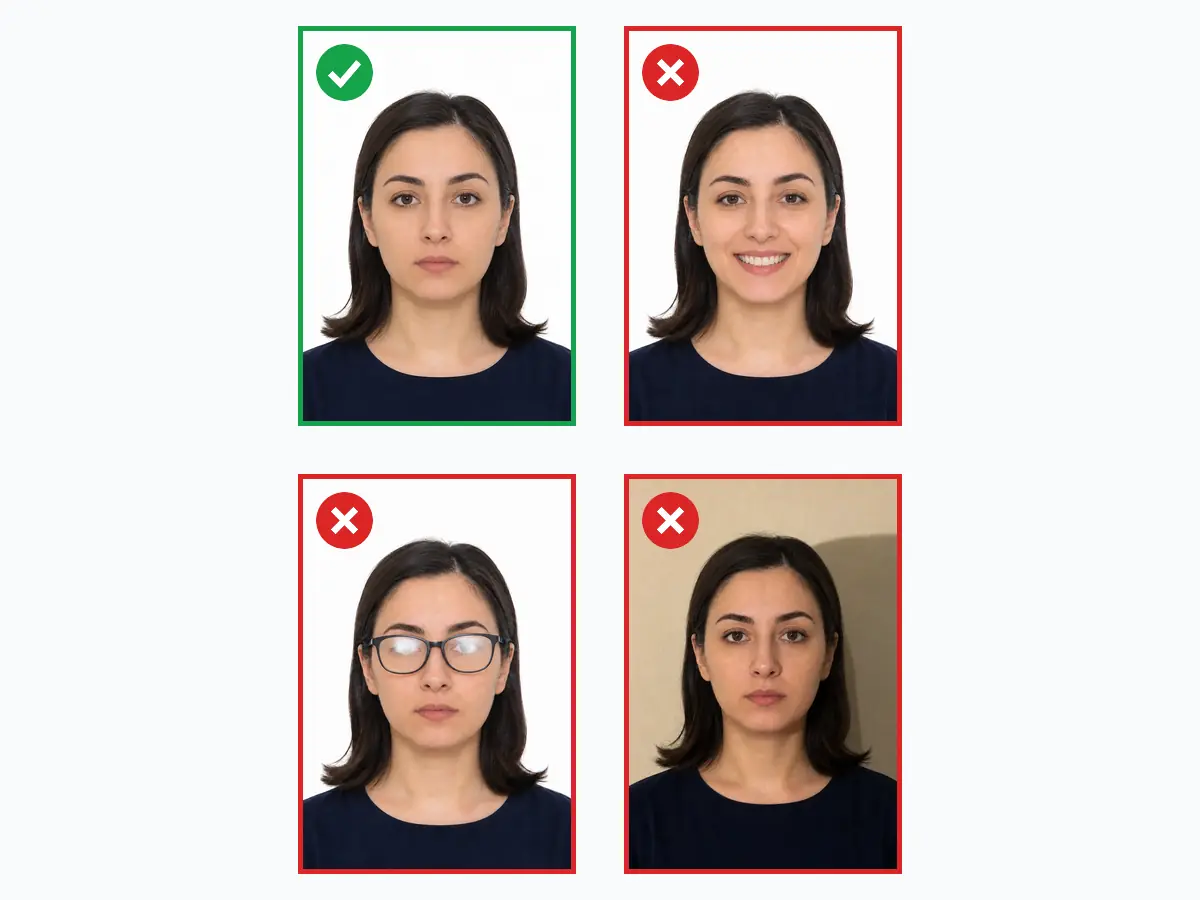
The official PRC Consular Department document (2016 announcement, still in force) states clearly: "Eyeglasses are allowed except thick-rimmed, tinted or glare glasses" — thick-frame, tinted/coloured or reflective glasses are banned. Technically, **thin-framed, clear, non-glare prescription glasses ARE allowed**. But practice is different: since 2025 the automated COVA photo checker tends to return "Photo check failed" the moment it detects glasses — experienced application agents therefore recommend shooting without glasses.
Coloured contacts, sunglasses and tinted lenses are always rejected. **Jewellery** (necklaces, earrings, non-religious head coverings) is also not accepted — China is stricter here than Schengen and the US. Religious head coverings (hijab etc.) are accepted only with formal documentation and while the face contour remains fully visible. There is also a measurable head-angle rule: **≤20° horizontal tilt left/right, ≤25° vertical tilt up/down** — anything more triggers automatic rejection.
China vs Russia vs Schengen: How Do the Three Compare?
| Criterion | China (COVA) | Russia | Schengen (VFS/TLScontact) |
|---|---|---|---|
| Size | 33×48 mm | 35×45 mm | 35×45 mm |
| Background | Pure white #FFFFFF (strict) | White / light matte grey | White / light grey |
| Head height | 28-33 mm | 32-36 mm | 32-36 mm |
| Digital file | JPEG 40-120 KB | Print-first | JPEG (portal-based) |
| Pixels | 354-420 × 472-560 px | Print 300 DPI | 413×531 – 826×1063 px |
| Colour | RGB required (B&W BANNED) | RGB preferred | RGB |
| Ears | Both REQUIRED visible | Visible (flexible) | Usually hair-tolerant |
| Bangs | BANNED — forehead/brows clear | Preferably clear | Forehead/brows clear |
| Glasses | Conditional (in practice: remove) | Non-glare allowed | Non-glare allowed |
| Jewellery | BANNED | Allowed | Allowed |
The table clarifies China's three distinctive rules: (1) the unique 33×48 mm size, (2) the strict bangs-forehead-ears policy, (3) the jewellery ban. A single burst is not enough for all three countries; each needs its own crop and optimisation. See the 35×45 mm size guide for the general background of the comparison.
For long-haired applicants, a practical tip: for China, use clips before the shoot to expose both ears and push bangs back off the forehead. If a Schengen or US application happens the same day, "two different poses" are not needed; the China-friendly pose (hair pinned back) works in both other countries — Schengen and the US are more relaxed, so the stricter China rule dominates.
What to Do If COVA Shows "Photo Check Failed"?
The automated COVA photo check that has been running since September 2025 is known to **often reject compliant photos**. The most common hidden causes: (1) a small trace of bangs on one corner of the forehead, (2) a hair strand covering one ear, (3) an imperceptible sideways head turn, (4) a soft shadow behind the head that the algorithm reads as "face obstruction". As a workaround, many application centres allow the application to continue with a compliant photo even after "Photo check failed" — the human consular officer can then manually review and accept the photo.
vesikalik.com.tr's "China mode" analysis report scores exactly the items COVA checks: pure white background (#FFFFFF comparison), head-height band, ear visibility, bangs-forehead clearance, lens glare, file size, pixel resolution and colour profile. Each row on a red-yellow-green scale; when everything turns green, the risk of COVA rejection drops to zero. From the same source selfie, additional versions can be produced for Russia visa or US visa — each country receives its own JPEG within its size and file limits.
Do's and Don'ts
Do
- Tie hair behind the ears; both eyebrows and both ears FULLY visible
- Clip bangs off the forehead — forehead and eyebrows uncovered
- Use a pure white (#FFFFFF) background — off-white and cream are rejected
- Wear a dark or medium-tone top (a white top blends into the background)
- Shoot in colour (RGB) — China does not accept black-and-white
Don't
- Do not wear thick-framed, coloured, tinted or glare glasses; even thin clear frames are risky on COVA — removing is safest
- No necklaces, earrings or non-religious head coverings — China does not accept jewellery in the photo
- Do not shoot in front of an off-white/cream/grey or tinted wall (COVA's auto-checker rejects them)
- Do not upload PNG, HEIC, WebP or TIFF — only JPEG; files under 40 KB or over 120 KB are rejected
- Do not shoot with bangs or hair covering the ears — the top rejection reason for Chinese visas
FAQ
Should I remove glasses for the photo?
What should I pay attention to when taking the photo?
What are the visa photo sizes and requirements?
Can I smile in a visa photo?
What are the China visa photo requirements?
Do I need a paper photo or a digital file for visa applications?
Is your photo ready?
Upload your photo, run the compliance check and download your print-ready photo in seconds.
Analyze Your Photo Now