



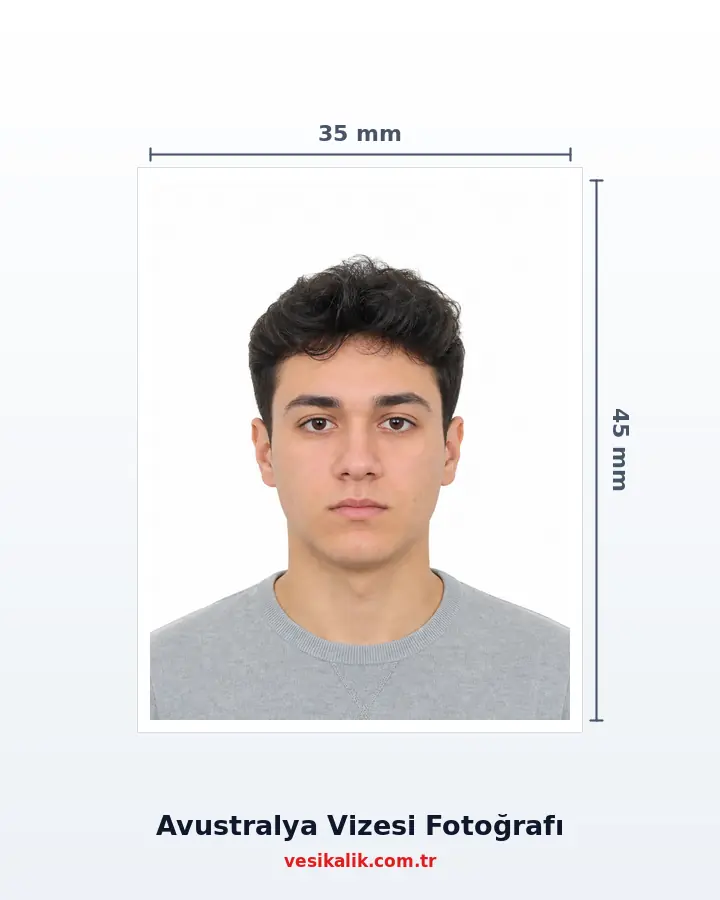
Australia Visa Photo — 35×45 mm for ImmiAccount and Print
Prepare the 35×45 mm photo for Australian visa applications (subclass 600, 500, 482, 189, 190, 820) via ImmiAccount with AI in 30 seconds — JPEG 70 KB – 3.5 MB, preferred 1200×1600 pixels, white or light grey background, no glasses, all per Home Affairs.
- Free analysis
- ICAO 9303
- AI-Powered
- GDPR compliant
Key takeaways
- ImmiAccount digital photo: JPEG 70 KB – 3.5 MB, preferred 1200×1600 px
- Glasses NOT allowed (rule since 2016); medical exemption needs a doctor's note
- Head height 32-36 mm from chin to crown
- Same 35×45 mm spec for subclass 600, 500, 482, 189, 190 and 820
Prepare the photo uploaded to ImmiAccount — or attached to a paper file — for Australian subclass 600 (visitor), 500 (student), 482 (worker), 189/190 (skilled migration), 820 (partner) and other visa and citizenship applications, all to Home Affairs standard.
How it works
Australia Visa Photo — 35×45 mm for ImmiAccount and Print — get it right in 4 steps.
-
Shoot with the rear camera in front of a plain wall
The front camera saves a mirrored frame that can weaken the biometric match; steady the phone at eye level and use a timer, or have someone else take the shot.
-
Upload the photo and start the Home Affairs check
The AI analyses the resolution (targeting 1200×1600 px), head ratio, glasses, background uniformity and mirror-image detection against ImmiAccount criteria.
-
Let the 35×45 mm crop apply automatically
The head is framed to the 32-36 mm band and the background moved to white/light grey; the JPEG is optimised into the ImmiAccount 70 KB – 3.5 MB band.
-
Upload the JPEG to ImmiAccount or order the prints
Upload the single file to the portal for online lodgement; paper applications need 2 identical prints — an 8-up 10×15 sheet ships to your address.
How much does an ID photo cost? (2026)
Photo analysis and the biometric compliance check are completely free. Digital file and print prices are below — identical to the live prices in the order wizard.
| Service | Price |
|---|---|
| Photo analysis & biometric check | Free |
| Digital File | 50.00 TRY |
| Australia Visa print package | 250.00 TRY |
| Cargo | 100.00 TRY |
Technical specifications
- Authority
- Department of Home Affairs (DHA) / ImmiAccount
- Digital size
- 35×45 mm; preferred 1200×1600 px (min. 900×1200 px)
- Head height
- 32–36 mm (chin to crown)
- Digital file
- JPEG, 70 KB – 3.5 MB, sRGB 24-bit
- Print size
- 35–40 mm × 45–50 mm (Passport Office range)
- Print quality
- Glossy 200+ gsm, dye-sublimation; inkjet NOT accepted
- Print count
- 2 identical copies (paper application)
- Background
- Plain white or light grey, uniform
- Freshness
- Taken within the last 6 months
Requirements checklist
- Digital JPEG within 70 KB – 3.5 MB (the ImmiAccount cap).
- Pixel resolution preferably 1200×1600, at least 900×1200 px.
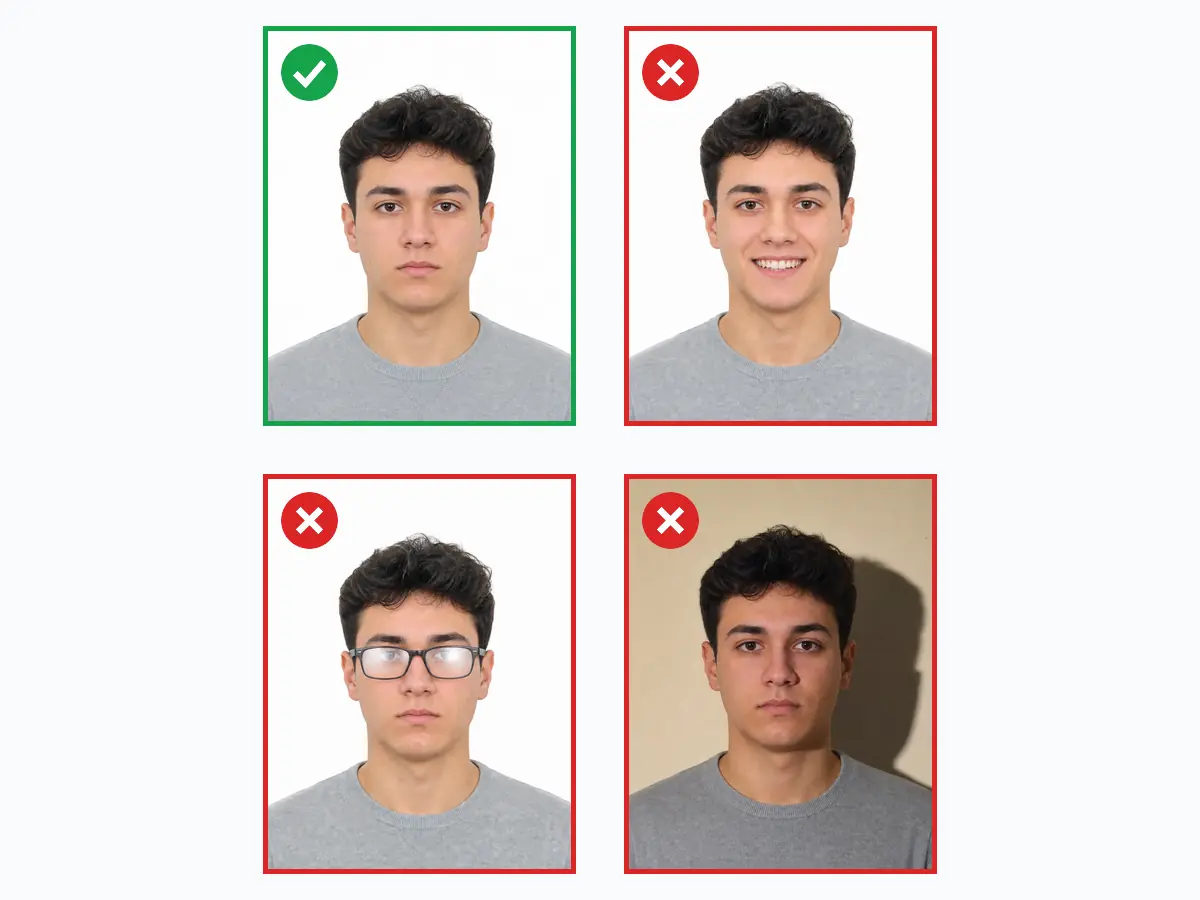
- Head from chin to crown 32-36 mm; face centred, looking straight at the camera.
- Glasses removed — banned on Australian visa photos since 2016.
- Plain white or light grey background; no shadows, patterns or gradients.
- Use the rear camera, not the front camera; avoid the mirror-image capture.
- Do not scan a printed photo or photograph another photo — not accepted.
- For paper applications: 2 identical glossy prints, 200+ gsm, dye-sublimation.
Related document sizes
Official photo sizes for documents related to this page, with pixel equivalents.
| Document | Physical size | Pixels (300 DPI) | Background | Note |
|---|---|---|---|---|
| Australia Visa | 3.5 × 4.5 cm | 413 × 531 px | White | ICAO compliant |
| United Kingdom Passport | 3.5 × 4.5 cm | 413 × 531 px | Cream / Light grey | ICAO compliant |
| EU Passport & Schengen Visa | 3.5 × 4.5 cm | 413 × 531 px | White or light grey | ICAO compliant |
| Bar Association ID | 3.5 × 4.5 cm | 413 × 531 px | White | ICAO biometric |
| US Passport & Visa | 5.1 × 5.1 cm (2×2 in) | 600 × 600 px | White | Square format required |
| Canada Visa | 5 × 7 cm | 591 × 827 px | White | IRCC, back-of-print note |
What Are the Australia Visa Photo Rules? (2026)
The Australian Department of Home Affairs attaches a biometric photo for identity verification to the first document of every electronic visa application submitted via ImmiAccount (subclass 600 visitor, 500 student, 482 skilled work, 189/190 skilled migration, 820 partner and others). The photo must be 35×45 mm, head height (chin to crown) 32-36 mm, background white or light grey, and taken within the last 6 months.
For the digital file Home Affairs is very explicit: JPEG format, file size between 70 KB and 3.5 MB, preferred resolution 1200×1600 pixels. That upper limit is roughly 15× the 240 KB cap of the US DS-160 portal — even if you already produced a photo for the US visa photo, you need a separate output for Australia. The file must use the sRGB, 24-bit colour profile and be delivered at a quality ImmiAccount's automatic checks can process. See the official guide at Home Affairs Photo Requirements.
Are Glasses Allowed on an Australia Visa Photo?
The short answer is no. Glasses have been banned on Australian biometric photos since 2016; because lens glare and a frame cutting across the pupil break the biometric match, the US, Australian and Schengen rules all converge on this point. Even clear prescription glasses are rejected; a medical exemption requires a signed doctor's statement.
The same strictness does not apply to head coverings: religious or medical head coverings are accepted as long as the forehead, jawline and face contour remain fully visible. Coloured contact lenses, sunglasses and face-shading hats are always rejected. vesikalik.com.tr's analysis knows this distinction: it flags a headscarf green but raises a red warning immediately when glasses are detected.
Why Do Selfies and Mirror Images Cause Problems?
Front-camera (selfie) photos are usually saved horizontally flipped by phones; because the face's natural asymmetry (eyebrows, lips, hair parting) appears reversed, the biometric algorithm lowers its confidence score. In addition to the "unedited" rule, Home Affairs also dislikes the wide-angle perspective distortion caused by a short selfie-stick distance (the "big nose" effect).
The safest way is to fix the phone at 1-1.5 m and use a timer with the rear (main) camera, or have someone else take the shot. vesikalik.com.tr compares the camera-subject relationship on your upload using the MediaPipe pose matrix; if a mirrored capture is detected, the report warns you and offers automatic correction — so you catch the issue before upload and can reshoot if needed.
How Many Pixels and MB Should an Australia Visa Photo Be?
| Portal | Physical | Pixels | File | Background |
|---|---|---|---|---|
| ImmiAccount (Australia) | 35×45 mm | 900×1200 – 1200×1600 px | JPEG 70 KB – 3.5 MB | White / light grey |
| DS-160 (USA) | 51×51 mm | 600×600 – 1200×1200 px | JPEG ≤ 240 KB | White |
| IRCC (Canada) | 50×70 mm | 420×540 px min | JPEG 60-240 KB | White / light |
| Home Office ETA (UK) | 45×35 mm | 600×750 px min | JPG/PNG < 3 MB | Cream / light grey |
| VFS/TLScontact (Schengen) | 35×45 mm | 413×531 – 826×1063 px | JPEG (print-first) | White / light grey |
As the table shows, Australia allows a file up to 15× the size of the US DS-160 cap and also asks for the highest pixel band. This reflects the shift to higher-resolution face-recognition maps in biometric verification during 2024-2026; files below 900×1200 pixels produce a "not enough detail" error on the ImmiAccount side.
vesikalik.com.tr processes your source photo targeting 1200×1600 pixels and keeps JPEG quality in the 90-95% band, ensuring it never drops below the 70 KB lower bound. For general information about the size see the 35×45 mm photo guide; for the official ImmiAccount lodgement flow see the Home Affairs online lodgement help page.
Why Is Print Quality Critical on a Paper Application?
Most Australian visa and citizenship applications are lodged electronically via ImmiAccount, but paper applications still exist (some offshore family visas, appeals). The Australian Passport Office standard applies here: 35–40 mm × 45–50 mm print, 2 identical copies, glossy photo paper at least 200 g/m², produced by dye-sublimation. Home-office inkjet printer output is refused by Home Affairs because the ink migrates in humid conditions and creates colour drift during biometric scanning.
vesikalik.com.tr produces its print version by dye-sublimation in a professional lab; 8 photos of 35×45 mm are laid out with cut marks on a 10×15 photo sheet and shipped to your address within Turkey. From the same source we can produce separately optimised outputs for Schengen, UK and Canada — each country receives a JPEG within its own pixel/file limits. The official definition of the print techniques is available at Australian Passport Office guidelines.
Do's and Don'ts
Do
- Shoot with the rear (main) camera — eliminate the mirror-image risk
- Aim for 1200×1600 px (minimum 900×1200 px)
- Keep the JPEG file size between 70 KB and 3.5 MB
- Use a plain, shadow-free white or light grey background
- Use a photo taken within the last 6 months
Don't
- Wear glasses — banned since 2016 unless medically exempt with a doctor's note
- Scan a printed photo or take a photo of a photo (Home Affairs refuses these)
- Apply filters, skin smoothing or background blur
- Smile, show teeth, open your mouth or raise your eyebrows
- Upload a file compressed below 70 KB or lower than 900×1200 resolution
FAQ
Should I remove glasses for the photo?
For which countries can I generate valid photos?
What should I pay attention to when taking the photo?
What are the visa photo sizes and requirements?
What are the Australia visa photo requirements?
Do I need a paper photo or a digital file for visa applications?
Is your photo ready?
Upload your photo, run the compliance check and download your print-ready photo in seconds.
Analyze Your Photo Now