



Schengen Visa Photo — 35×45 mm EU Visa Code
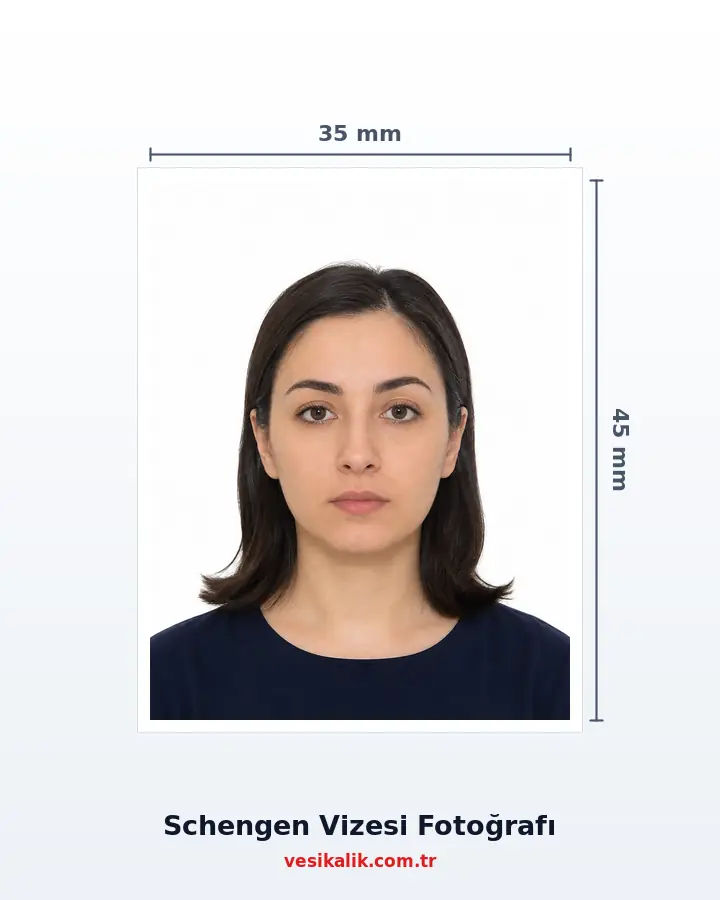
For a tourist, business, student or family-visit visa application to the 29 Schengen states (Germany, France, Italy, Spain, Netherlands, Greece, Bulgaria, Romania + 21 more), prepare the 35×45 mm biometric photo you submit via VFS Global / TLScontact / iDATA / BLS with AI in 30 seconds — EU Visa Code Annex VI + ICAO 9303 compliant, 32-36 mm head height, light grey background, optimised for the VIS biometric quality score.
- Free analysis
- ICAO 9303
- AI-Powered
- GDPR compliant
Key takeaways
- 29 Schengen countries in 2026 (Croatia 2023, Bulgaria + Romania 2024/2025)
- 35×45 mm, head 32-36 mm, light grey background (white may fail for Germany)
- €90 adult / €45 child (6-12) / free 0-6 — 2025 fee increase
- VFS Global / TLScontact / iDATA (Germany) / BLS — digital upload differences
Prepare the 35×45 mm biometric photo you submit via VFS Global / TLScontact / iDATA / BLS for short-stay (Type C, 90/180 rule) Schengen visa applications — tourism, business, student, family visit or cultural/sports events — to any of the 29 Schengen states including Germany, France, Italy, Spain, Netherlands, Greece, Bulgaria, Romania and Croatia.
How it works
Schengen Visa Photo — 35×45 mm EU Visa Code — get it right in 4 steps.
-
Pick the VAC: VFS, TLS, iDATA or BLS
For Germany [[ext:https://www.idata.com.tr|iDATA]], for France/Switzerland TLScontact, for most of Italy/Netherlands/Greece/Spain VFS Global, for some regions of Spain BLS International. Each VAC has different digital-upload size/limit rules.
-
Shoot in front of a plain wall with a neutral expression
Phone at eye level; removing glasses is safest (Germany bans glasses entirely). Neutral expression, mouth closed, eyes open, direct look — the VIS automated biometric quality score has been active since 2025.
-
Upload the photo and get the Schengen check
The AI scores the 32-36 mm head-height band, 70-80% face ratio, light grey background and eye line against EU Visa Code Annex VI. A Germany-strict mode (fixed 32-36 mm, no glasses) can be auto-selected.
-
Ship / upload two formats: 2 prints + digital JPEG
For the VAC appointment 2 identical 35×45 mm prints (8-up with cut marks on a 10×15 sheet). The digital JPEG is auto-optimised per portal (VFS: 400×514–1054×1350 px max 5 MB; TLS: 60-300 KB 600×800–1200×1600 px).
How much does an ID photo cost? (2026)
Photo analysis and the biometric compliance check are completely free. Digital file and print prices are below — identical to the live prices in the order wizard.
| Service | Price |
|---|---|
| Photo analysis & biometric check | Free |
| Digital File | 50.00 TRY |
| EU Passport & Schengen Visa print package | 250.00 TRY |
| Cargo | 100.00 TRY |
Technical specifications
- Standard
- EU Visa Code Annex VI (Reg. 810/2009) / ICAO 9303
- Authority
- EU consular network — 29 member states / VFS / TLS / iDATA / BLS
- Size
- 35×45 mm (portrait)
- Head height
- 32–36 mm (face 70-80% of the frame)
- Background
- Light grey (preferred); white may fail in Germany/France/Switzerland
- Colour
- RGB colour, natural skin tone
- Quantity
- 2 identical prints + 1 digital JPEG (VAC portal)
- VFS digital
- JPEG 400×514–1054×1350 px, max 5 MB
- TLS digital
- JPEG 60-300 KB, 600×800–1200×1600 px
- Glasses
- Glare-free allowed in EU baseline; BANNED for Germany
- Fee 2026
- €90 adult / €45 (6-12) / 0-6 free
- Processing
- Standard 15 days / express 5 working days / high season up to 45
- VIS scoring
- Automated biometric quality since 2025 (≥0.6 required)
- Fingerprints
- 5-year validity (extended from 4.5 in 2026)
- Freshness
- Photo last 6 months; visa 90/180 rule
Requirements checklist
- Size 35×45 mm; head 32-36 mm (face 70-80%).
- Light grey background (white risky for Germany).
- 2 identical prints + digital JPEG (per VAC portal size).
- Neutral expression, mouth closed, eyes open, looking straight at the camera.
- Germany: glasses fully BANNED; others allow glare-free.
- Photo within the last 6 months, colour (RGB), no retouching.
- Fee €90 + VAC service fee payment ready.
- Optimised for VIS biometric score ≥0.6.
- 90/180 rule: max 90 days travel within a rolling 180-day window.
- EES 2026: fingerprints + face image biometric border check.
Related document sizes
Official photo sizes for documents related to this page, with pixel equivalents.
| Document | Physical size | Pixels (300 DPI) | Background | Note |
|---|---|---|---|---|
| EU Passport & Schengen Visa | 3.5 × 4.5 cm | 413 × 531 px | White or light grey | ICAO compliant |
| Bar Association ID | 3.5 × 4.5 cm | 413 × 531 px | White | ICAO biometric |
| United Kingdom Passport | 3.5 × 4.5 cm | 413 × 531 px | Cream / Light grey | ICAO compliant |
| Australia Visa | 3.5 × 4.5 cm | 413 × 531 px | White | ICAO compliant |
| US Passport & Visa | 5.1 × 5.1 cm (2×2 in) | 600 × 600 px | White | Square format required |
| Passport (TR) | 5 × 6 cm | 591 × 709 px | White | ICAO biometric |
| Russia Visa | 3.5 × 4.5 cm | 413 × 531 px | White | Compatible with most countries |
| Canada Visa | 5 × 7 cm | 591 × 827 px | White | IRCC, back-of-print note |
Schengen Visa Photo Rules (2026): One Standard for 29 Countries
As of 2026 the Schengen Area comprises **29 member states**: Croatia joined in 2023, Bulgaria and Romania in 2024/2025 (air/sea in March 2024, land borders in January 2025), replacing the classic 27. A Schengen Type C visa is valid across **all 29 states** and grants 90 days of travel within a rolling 180-day window. The photo standard is unified across all 29 countries by the EU Visa Code (Regulation EC 810/2009, Annex VI): 35×45 mm portrait, ICAO 9303 compliant, light grey background, 32-36 mm head height.
The same standard is shared with UK visa (BRP), Australia visa and 35×45 mm passports; see the 35×45 mm photo page for size details. **Since 2026 the photo also goes through the automated VIS biometric quality score**: a score below 0.6 on the 0-1 scale flags the photo as "retake required" and adds 2-4 weeks to processing. vesikalik.com.tr checks exactly the criteria VIS measures — head angle, face ratio, background uniformity and eye alignment.
VFS Global, TLScontact, iDATA, BLS: Which One Applies to You?
| VAC | For which country | Digital JPEG spec | Strictness note |
|---|---|---|---|
| iDATA | Germany (official intermediary in Turkey) | Portal-specific: 300 KB – 2 MB, min 400×514 | STRICTEST: light-grey background, glasses fully banned, 32-36 mm fixed |
| VFS Global | Italy, Netherlands, Greece, Spain, Belgium, Austria, etc. | JPEG 400×514 – 1054×1350 px, max 5 MB | EU baseline (flexible): glare-free glasses allowed |
| TLScontact | France, Switzerland, Belgium (some regions) | JPEG 60-300 KB, 600×800 – 1200×1600 px | Medium strictness: cream-to-grey background range, glare-free glasses allowed |
| BLS International | Spain (some regions), Portugal | JPEG varies per portal | Head-position ±2 mm centring strictness |
| Direct consulate | Special cases (family reunification, etc.) | Varies per consulate | Full literal ICAO 9303 enforcement |
For applicants **living in Turkey**, the critical distinction is Germany vs the rest: **Germany applications go through iDATA**, and iDATA applies the strictest criteria — light-grey background mandatory (white typically marked as "not preferred"), glasses **fully banned** (even where EU baseline allows), head height fixed at 32-36 mm (no flexibility). VFS Global, TLScontact and BLS follow the EU baseline and are more flexible.
vesikalik.com.tr's "Schengen mode" auto-adjusts rules by chosen country: for Germany the "Germany-strict mode" activates (glasses trigger a red flag, light grey background enforced); for France/Switzerland medium strictness; for Italy/Netherlands EU baseline. The same source shot can produce different optimised outputs for multiple Schengen countries on the same day.
The Most Critical Measurement: 32–36 mm Head Height and VIS Scoring
The most common technical reason for Schengen rejections is head height: 32–36 mm from chin to crown, with the face covering **70–80%** of the frame height. The eyes must also sit within a specific band above the bottom edge. Since 2025, the **VIS (Visa Information System) automated biometric quality score** has been live: a score below **~0.6** on the 0-1 scale flags the photo as "retake required" and adds 2-4 weeks of delay to processing.
vesikalik.com.tr measures this distance with sub-millimetre precision using MediaPipe FaceLandmarker's 478-point face mesh, automatically re-frames the crop, and scores every parameter VIS checks (head angle, face symmetry, eye alignment, expression neutrality) in one report. No more manual cropping, ruler measuring or template alignment. See the 35×45 mm size guide for general background.
Germany's Special Strictness: Why Photos Fail at iDATA?
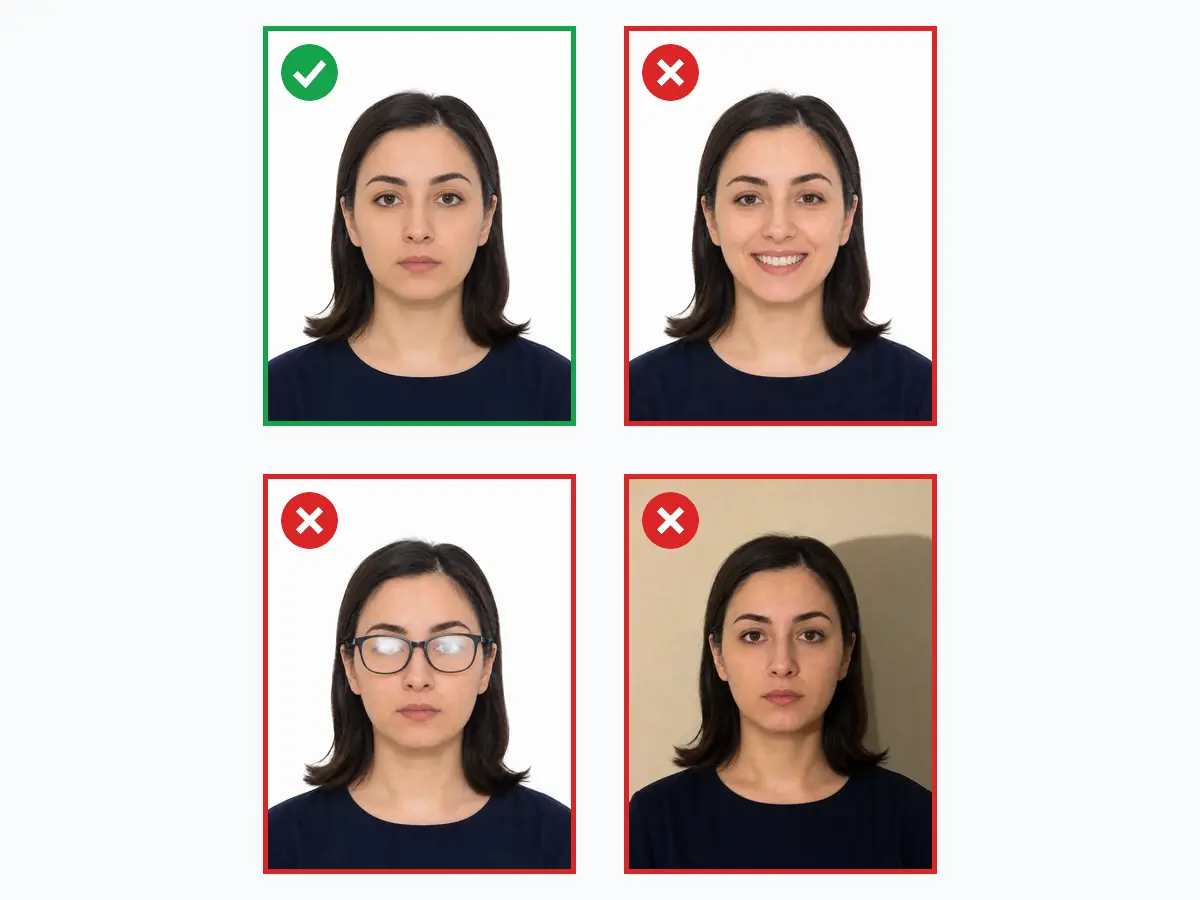
The German consulate and iDATA photo review apply three specific rules: **(1) only light-grey background** — white is flagged as "not preferred" and often rejected; **(2) glasses ARE FULLY BANNED** — even though the EU baseline allows glare-free glasses, Germany asks for them to be removed without exception; **(3) exact head height 32-36 mm** — 31 mm or 37 mm is rejected (other countries tolerate 1-2 mm slack). These three rules can turn back an application at the iDATA appointment; a paid on-site retake is required.
French and Italian consulates are more flexible: **France (TLScontact)** accepts a cream-to-grey background range and allows glare-free prescription glasses; **Italy (VFS)** follows the EU baseline; **Spain (BLS)** applies a ±2 mm centring strictness on head position; **Switzerland** enforces ICAO 9303 literally. In an "unknown consulate" scenario (an application through a VFS centre where the decision can spread across several consulates) the safest strategy is the strictest combination: light-grey background (RGB ~210,210,210), 32-36 mm head, glasses removed, fully neutral expression.
What Changed in 2026? EES, ETIAS and the Fee Increase
Schengen saw its biggest changes in a decade during 2026: **(1) EES (Entry/Exit System)** went fully operational on 10 April 2026 — manual passport stamping ended at the 29 Schengen borders; instead **fingerprints + face image** biometric checks apply. This speeds up crossings but adds no new photo requirement on the visa application side. **(2) ETIAS** launches Q4 2026 (€20, valid 3 years); but ETIAS is **only for visa-exempt countries** — since Turkish citizens are in the visa-required group, they do not apply for ETIAS.
**(3) Fee increase**: 2025 raised €80 → €90 for adults and €40 → €45 for children (6-12) — the first increase since 2020. Under-6 remains free. **(4) Express processing dropped from 7 to 5 working days**. **(5) Fingerprint validity extended from 4.5 to 5 years**. **(6) The digital Schengen visa pilot continues** — some embassies accept fully online forms; a full physical-to-digital visa sticker rollout is targeted for 2027-28. The same 35×45 mm size can be re-optimised from a single shot for Russia visa, UK visa and US visa via vesikalik.com.tr; the same 6-month freshness applies to the general passport photo.
Do's and Don'ts
Do
- Keep head height in the 32-36 mm band (face 70-80% of the frame)
- Use a light grey background — white may be rejected in Germany/France/Switzerland
- A colour (RGB) photo taken within the last 6 months
- Take 2 identical 35×45 mm printed copies to the VAC appointment
- Prepare the digital version to the specific pixel/file limits of the VFS/TLS/iDATA portal
Don't
- No smiling, showing teeth, open mouth or raised eyebrows
- Do not submit a photo with glasses for Germany (a strict ban)
- No photo older than 6 months or retouched (AI edit / filter)
- Do not upload the wrong size to the wrong VAC portal (VFS ≠ TLS specs)
- No hats, bandanas or face-shading accessories
FAQ
For which countries can I generate valid photos?
What should I pay attention to when taking the photo?
What are the visa photo sizes and requirements?
Can I wear a headscarf in a visa photo?
Can I smile in a visa photo?
What are the Schengen visa photo requirements?
Do I need a paper photo or a digital file for visa applications?
Is your photo ready?
Upload your photo, run the compliance check and download your print-ready photo in seconds.
Analyze Your Photo Now