



Baby Passport Photo — At-Home Guide with Newborn Tolerances
Prepare the biometric photo for a baby passport, Turkish chipped ID and international visa applications with AI in 30 seconds — closed eyes for newborns (officially accepted by the US and UK), bedsheet and car-seat method, best frame picked automatically from a burst.
- Free analysis
- ICAO 9303
- AI-Powered
- GDPR compliant
Key takeaways
- Newborns (age 0-1): closed eyes are ACCEPTED by the US and UK (official)
- Parent's face and hands must not appear — the baby is alone in the frame
- Bedsheet method or car-seat + white cover method for at-home shoots
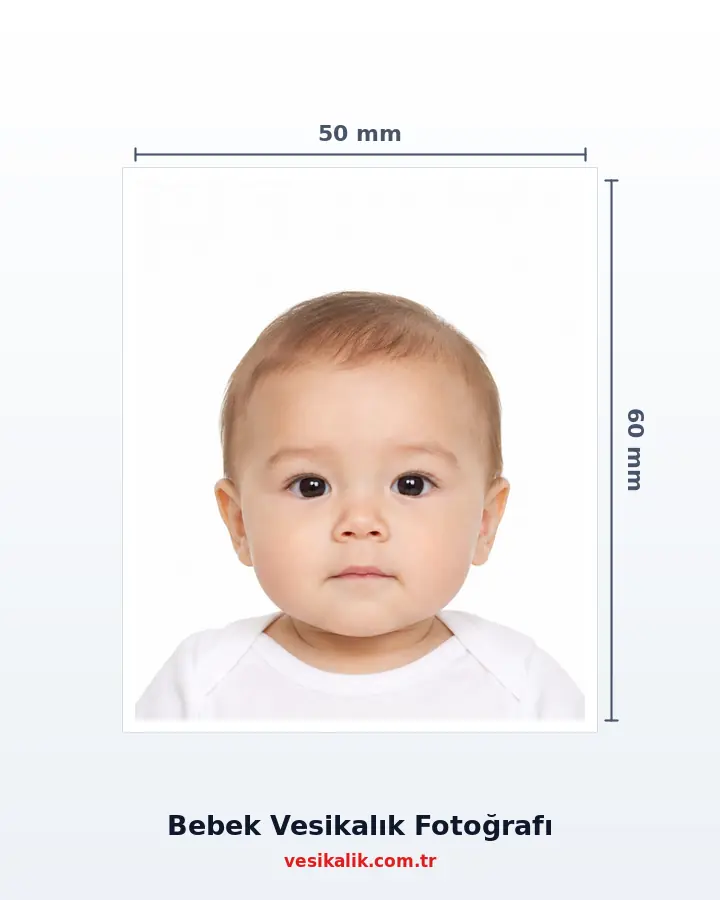
- US 51×51 mm, UK 35×45 mm, Canada 50×70 mm, Turkey 50×60 mm — per country
Prepare the biometric photo required for a newborn / 0-6 year-old baby's Turkish chipped ID, first passport (Turkish or dual citizenship), US B1/B2 or citizenship, UK, Schengen, Canada and Australia visa applications — all from home.
How it works
Baby Passport Photo — At-Home Guide with Newborn Tolerances — get it right in 4 steps.
-
Prepare a white sheet or a car seat + white cover
The US State Department officially accepts the car-seat method: a rear-facing car seat draped with a plain white/off-white cover. Alternative: lay the baby on its back on a plain white sheet on a bed.
-
Catch an awake, calm moment and shoot a burst
Hold the phone 60-80 cm away, straight overhead (bedsheet method) or head-on (car-seat method); draw the gaze with a sound; keep toys, pacifier lanyards and adult hands out of the frame.
-
Let the AI pick the best frame and run country checks
The AI scores eye openness (closed OK for newborns), head angle, and second-person/accessory detection against each country's rules.
-
Download the digital file or ship the print sheet
US 51×51 mm, UK 35×45 mm, Canada 50×70 mm and TR 50×60 mm outputs are all produced from the same source; a 10×15 sheet with 6-8 prints ships to your address.
How much does an ID photo cost? (2026)
Photo analysis and the biometric compliance check are completely free. Digital file and print prices are below — identical to the live prices in the order wizard.
| Service | Price |
|---|---|
| Photo analysis & biometric check | Free |
| Digital File | 50.00 TRY |
| Passport (TR) print package | 250.00 TRY |
| Cargo | 100.00 TRY |
Technical specifications
- Age range
- 0-6 years (country-specific tolerances)
- Size (TR)
- 50×60 mm — chipped ID and passport
- Size (US)
- 51×51 mm (2×2 inch) — B1/B2, passport
- Size (UK)
- 35×45 mm — passport, ETA (last 1 month!)
- Size (Canada)
- 50×70 mm — IRCC passport
- Head height
- US 25-35 mm, UK 29-34 mm, Canada 31-36 mm, TR 32-36 mm
- Background
- White or very light grey / cream (UK); uniform, shadow-free
- Eyes
- US and UK: closed eyes accepted for newborns; open required from age 1
- Head support
- Allowed as long as the parent's hand/shoulder is not visible
- Freshness
- 6 months in most countries; 1 month in the UK
Requirements checklist
- Only the baby in the frame; no parent's face, hands or shoulders visible.
- Plain white sheet or car seat + white cover — no patterned blankets.
- Newborn's eyes may be fully closed (US/UK); open required from age 1.
- Closed mouth preferred; slight opening tolerated for babies.
- Head upright or slightly tilted — the US explicitly allows infant head tilt.
- No hair covering the face; no toys, pacifiers or pacifier lanyards in view.
- Photo close to the application date; last 1 month for the UK.
Related document sizes
Official photo sizes for documents related to this page, with pixel equivalents.
| Document | Physical size | Pixels (300 DPI) | Background | Note |
|---|---|---|---|---|
| Passport (TR) | 5 × 6 cm | 591 × 709 px | White | ICAO biometric |
| National ID Card (TR) | 5 × 6 cm | 591 × 709 px | White | ICAO biometric |
| 50×60mm Biometric Photo | 5 × 6 cm | 591 × 709 px | White | ICAO biometric |
| Bar Association ID | 3.5 × 4.5 cm | 413 × 531 px | White | ICAO biometric |
| US Passport & Visa | 5.1 × 5.1 cm (2×2 in) | 600 × 600 px | White | Square format required |
| United Kingdom Passport | 3.5 × 4.5 cm | 413 × 531 px | Cream / Light grey | ICAO compliant |
| Canada Visa | 5 × 7 cm | 591 × 827 px | White | IRCC, back-of-print note |
Are Closed Eyes Accepted on a Newborn's Passport Photo? (2026)
A common source of stress: new parents assume the passport application will be refused if they cannot keep the baby's eyes open. In fact, two major authorities officially accept it. The US State Department's "8 FAM 402.1" states word-for-word: "It is acceptable if the infant's eyes, particularly a newborn's, are partially or completely closed." The same document allows head tilt for infants.
The UK's HM Passport Office writes on gov.uk: "Children under one do not have to have their eyes open." Canada IRCC is a bit more conservative but grants expression tolerance to newborns. This flexibility is widely miscommunicated: many studios and online guides tell parents "the eyes must be open" for a baby passport photo. See the primary sources at 8 FAM 402.1 (US State Department) and gov.uk passport photos.
What Does Each Country Require for Baby Photos? Size & Rule Comparison
| Country | Size | Head height | Background | Newborn eyes | Freshness |
|---|---|---|---|---|---|
| United States (State Department) | 51×51 mm (2×2 in) | 25-35 mm | White / off-white | Closed OK (8 FAM 402.1) | 6 months |
| United Kingdom (HM Passport Office) | 35×45 mm | 29-34 mm | Cream / light grey | Under 1 year not required to be open | 1 month |
| Canada (IRCC) | 50×70 mm | 31-36 mm | White / light | Expression tolerance; eyes should be open | 6 months |
| Schengen (EU) | 35×45 mm | 32-36 mm | White / light grey | Usually open; some consulates flexible | 6 months |
| Turkey (NVİ) | 50×60 mm | 32-36 mm | White / light grey | Open preferred; tolerant assessment | 6 months |
| Australia (Home Affairs) | 35×45 mm | 32-36 mm | White / light grey | Usually open; expression tolerance | 6 months |
As the table shows, Canada IRCC and Australia are the strictest on baby photos, while the US and UK are the most lenient. Because a definite head-height band exists per country, vague claims like "17-36 mm flexible for infants" are not needed — every country has a fixed range and vesikalik.com.tr crops each output to its own country's band. For document-specific rules see the US visa photo, UK visa photo, Canada visa photo, Schengen visa photo and passport photo guides.
Critical detail: the UK applies the "last 1 month" freshness rule to baby passport photos (same as adults) — a 6-month-old photo is not accepted in the UK. The US and Canada keep the 6-month standard, but IRCC also states "your child's photo must show how your child looks now", which naturally requires a more recent photo for babies. Source: Canada.ca passport photo requirements.
Bedsheet or Car-Seat Method: Which Fits Your Baby?
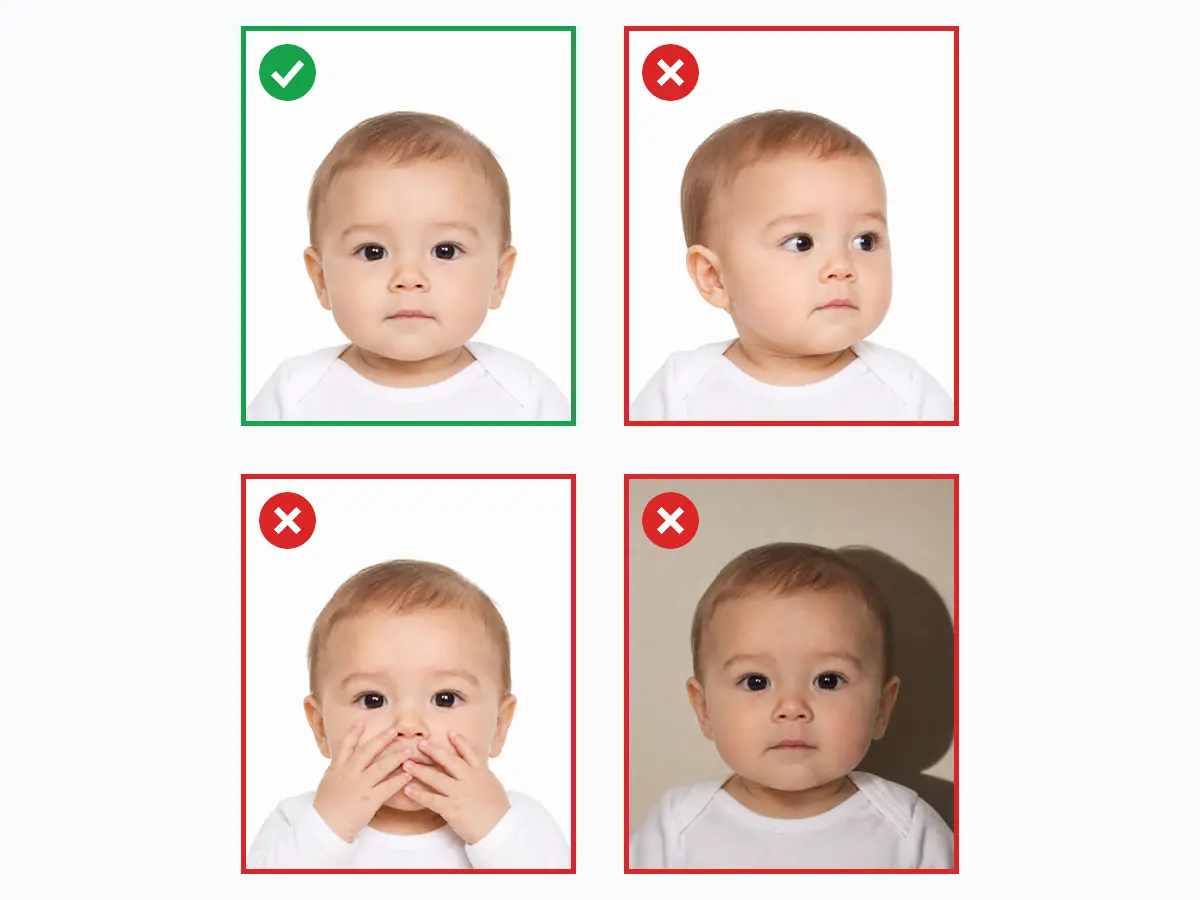
Two official methods work at home. **Bedsheet method**: lay the baby on its back on a plain white sheet or blanket (no patterns) and hold the phone about 60-80 cm above, parallel to the baby's face. A ceiling lamp casts a harsh shadow under the nose — soft side daylight from a window is ideal. This method is more comfortable for newborns because they do not need to hold their neck up.
The **car-seat method** is officially recommended by the US (travel.state.gov, 8 FAM 402.1): drape a rear-facing car seat with a plain white or off-white sheet/blanket and place the baby in the seat — the straps and background disappear under the sheet. This works well for 3-6 month olds who can hold their head. In both methods the key rule is the same: **the parent's face, arm, shoulder or finger must not appear in the frame**. UK gov.uk explicitly states that you can support the baby's head with your hand, but your hand must not be visible in the final photo. vesikalik.com.tr reports second-person detection as a red flag when picking the best burst frame.
How Does Baby Mode Work for Age-Specific AI Analysis?
vesikalik.com.tr's "baby mode" extracts an age-specific landmark set from the pose matrix: the chin-shoulder angle, critical in adults, uses a looser threshold for babies, and the expression and eye-openness checks are calibrated to the official rule of the country you pick. When producing a US output for a newborn, closed eyes do not raise a red flag; when producing an output for age 1+, they do. The report instead highlights baby-specific metrics like "second adult visibility", "accessory detection", "pacifier lanyard" and "patterned blanket".
The MediaPipe FaceLandmarker 478-point mesh also works on baby faces, but the confidence score is slightly lower because of softer facial contours. That is why a burst is essential: the highest-scoring frame among 5-10 is picked automatically. No "photo not acceptable, please retake" surprise at the civil-registry or consulate counter — the problem is fixed at home during the shoot, and the report shows exactly which criterion stayed yellow/red.
Printing, Shipping, and Multiple Countries From One Shot
The digital output is produced at the right size for the country you pick: 50×60 mm for Turkey, 35×45 mm for international, 51×51 mm for the US, 50×70 mm for Canada. On the print side, 6-8 photos are laid out with cut marks on a 10×15 photo sheet and shipped within Turkey. The best frame from a single burst can go to the Turkish civil registry on one side and to the US consulate on the other — because babies change quickly, it is practical to cover several documents from one shoot.
Most baby passport / ID applications happen once, with parents present: the Turkish chipped ID right after birth, the first passport for foreign travel, and a US B1/B2 or Schengen visa if needed. vesikalik.com.tr produces outputs to four country standards from one at-home burst. For verified rules on other sizes see the passport photo and ID card guides; for the US the official definition lives at travel.state.gov passport photos.
Do's and Don'ts
Do
- Shoot on a white sheet from directly above, or use the car-seat + white-cover method
- Wait for a moment when the baby is awake and calm; use daylight
- Take a burst — vesikalik.com.tr picks the best frame automatically
- Don't worry if a newborn's eyes are not fully open (US and UK officially accept it)
- Take the photo as close to the application date as possible; the UK requires within the last month
Don't
- Do not leave adult hands, arms, shoulders or a parent's face in the frame
- No toys, pacifiers, pacifier lanyards or patterned blankets in view
- No hats, headbands, necklaces or face-covering accessories
- Do not shoot under a ceiling lamp — it leaves a hard shadow under the nose
- Do not apply filters or retouching beyond background clean-up (officially banned)
FAQ
How should I take my photo?
For which countries can I generate valid photos?
What should I pay attention to when taking the photo?
What are the passport photo size and requirements?
How do I take a baby passport photo at home?
Can a baby's eyes be closed in a passport photo?
Is your photo ready?
Upload your photo, run the compliance check and download your print-ready photo in seconds.
Analyze Your Photo Now